
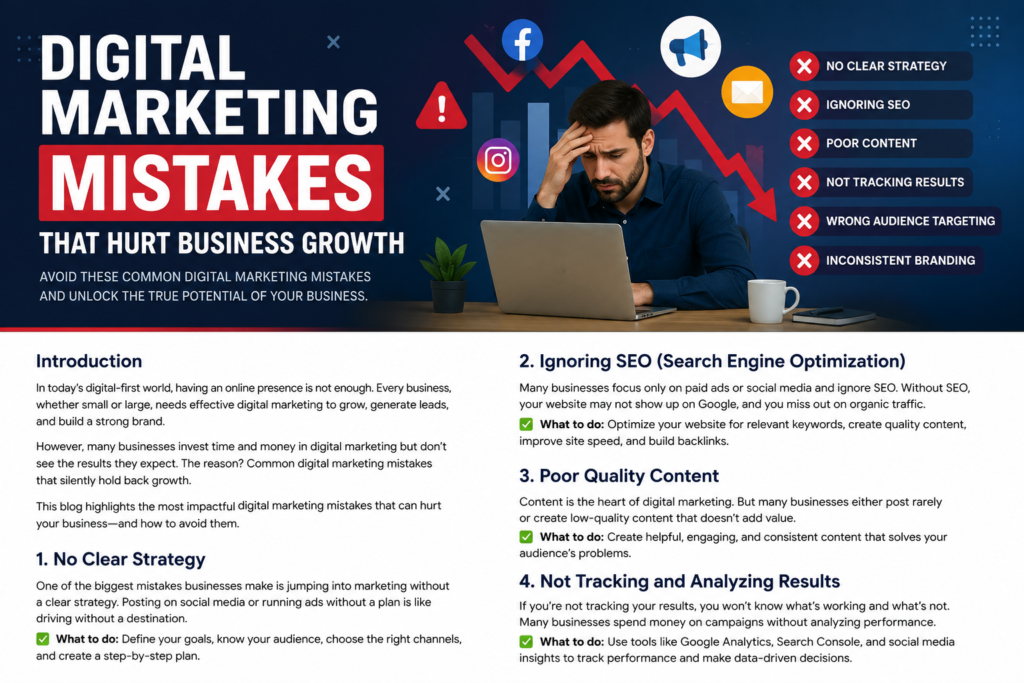
Introduction
In today’s digital-first world, having an online presence is no longer optional—it’s essential. Whether you’re a startup, a local business, or an established brand, digital marketing plays a vital role in reaching your target audience, generating leads, and driving long-term growth.
However, many businesses invest significant time and money in digital marketing without seeing the results they expect. The reason is often not the lack of effort, but common mistakes that reduce campaign effectiveness and limit business growth. From ignoring search engine optimization (SEO) to failing to understand customer behavior, these errors can prevent your marketing strategy from delivering meaningful results.
In this blog, we’ll explore the most common digital marketing mistakes that hurt business growth and discuss practical ways to avoid them.
1. Starting Without a Clear Digital Marketing Strategy
One of the biggest mistakes businesses make is jumping into digital marketing without a well-defined strategy. Posting randomly on social media, running advertisements without goals, or creating content without a purpose often leads to wasted resources.
A successful digital marketing strategy begins with clear objectives. Whether your goal is to increase website traffic, generate leads, improve brand awareness, or boost online sales, every marketing activity should support that objective.
How to avoid it:
- Define measurable marketing goals.
- Identify your target audience.
- Choose the right digital marketing channels.
- Create a monthly marketing plan.
- Monitor and adjust your strategy regularly.
2. Ignoring Search Engine Optimization (SEO)
Many businesses focus solely on paid advertising while neglecting SEO. Although paid campaigns provide quick visibility, SEO delivers sustainable, long-term traffic by helping your website rank higher in search engine results.
Without SEO, potential customers may never discover your business when searching for products or services online.
Common SEO mistakes include:
- Poor keyword research
- Duplicate content
- Slow website speed
- Missing meta titles and descriptions
- Lack of internal linking
How to avoid it:
- Research relevant keywords.
- Optimize every page for search intent.
- Publish valuable, original content.
- Improve website loading speed.
- Build high-quality backlinks.
SEO is a long-term investment that continues generating organic traffic long after content is published.
3. Producing Low-Quality Content
Content is one of the most powerful tools in digital marketing. Unfortunately, many businesses publish content simply to stay active online rather than to provide value.
Poor-quality blogs, repetitive social media posts, and promotional content that lacks useful information rarely engage audiences.
High-quality content should educate, solve problems, answer customer questions, and establish your brand as an industry expert.
How to avoid it:
- Understand your audience’s needs.
- Write informative and engaging articles.
- Use visuals, videos, and infographics.
- Keep content updated.
- Focus on quality rather than quantity.
Remember, valuable content builds trust, and trust leads to conversions.
4. Not Understanding Your Target Audience
Many marketing campaigns fail because businesses try to reach everyone instead of focusing on the right audience.
Without understanding customer demographics, interests, behaviors, and pain points, marketing messages become too generic.
Customer research helps businesses create personalized experiences that resonate with potential buyers.
How to avoid it:
- Develop buyer personas.
- Conduct customer surveys.
- Analyze website and social media insights.
- Study customer feedback.
- Personalize marketing campaigns.
The better you understand your audience, the more effective your marketing becomes.
5. Neglecting Mobile Optimization
Today, most internet users browse websites using smartphones. If your website isn’t mobile-friendly, visitors are likely to leave before exploring your products or services.
A poor mobile experience affects user satisfaction, search engine rankings, and conversion rates.
Common mobile issues include:
- Slow loading pages
- Difficult navigation
- Small text
- Poor image optimization
- Unresponsive layouts
How to avoid it:
- Use responsive website design.
- Optimize images.
- Improve page speed.
- Simplify navigation.
- Test your website across different devices.
A seamless mobile experience encourages visitors to stay longer and engage with your business.
6. Focusing Only on Selling
Many businesses treat every social media post or advertisement as a sales pitch. While promotions are important, constant selling can overwhelm audiences.
Digital marketing should focus on building relationships before asking customers to make a purchase.
Educational content, customer success stories, tutorials, and behind-the-scenes updates create stronger connections.
Follow the 80/20 rule:
- 80% valuable and educational content
- 20% promotional content
This balanced approach increases trust and long-term customer loyalty.
7. Ignoring Social Media Engagement
Simply posting on social media isn’t enough. Engagement is what builds community and strengthens customer relationships.
Many businesses fail to respond to comments, ignore direct messages, or rarely interact with followers.
Social media platforms reward active engagement by increasing content visibility.
How to avoid it:
- Reply to comments quickly.
- Answer customer questions.
- Encourage conversations.
- Use polls and interactive stories.
- Build genuine relationships.
Engaged audiences are more likely to become loyal customers.
8. Not Tracking Marketing Performance
Without measuring results, businesses cannot determine whether their marketing efforts are successful.
Many companies continue investing in campaigns without analyzing what works and what doesn’t.
Key metrics include:
- Website traffic
- Conversion rate
- Bounce rate
- Cost per lead
- Return on investment (ROI)
- Click-through rate (CTR)
Use tools like:
- Google Analytics
- Google Search Console
- Meta Business Suite
- Google Ads Dashboard
Data-driven decisions help businesses improve performance and maximize marketing budgets.
9. Inconsistent Branding
Your brand should deliver a consistent experience across your website, social media, advertisements, and email marketing.
Inconsistent logos, messaging, colors, or tone of voice confuse customers and reduce brand recognition.
Strong branding creates trust and makes businesses more memorable.
Maintain consistency in:
- Logo
- Typography
- Color palette
- Brand voice
- Messaging
- Visual style
A consistent brand identity strengthens customer confidence and supports long-term growth.
10. Expecting Instant Results
Digital marketing is not a one-time activity or a shortcut to overnight success.
SEO takes time to build authority, content marketing requires consistency, and social media growth happens gradually.
Businesses that quit after a few weeks often miss the long-term benefits of sustained marketing efforts.
Successful digital marketing requires:
- Patience
- Consistency
- Continuous optimization
- Testing different strategies
- Learning from performance data
The businesses that stay committed usually achieve the best results.
Conclusion
Digital marketing offers incredible opportunities for business growth, but only when executed strategically. Common mistakes such as ignoring SEO, producing low-quality content, failing to understand your audience, neglecting analytics, and expecting immediate success can significantly limit your growth potential.
The good news is that these mistakes are preventable. By developing a clear marketing strategy, creating valuable content, optimizing your website, tracking campaign performance, and maintaining consistent branding, you can build a strong digital presence that drives measurable business results.
Digital marketing is an ongoing journey of learning, testing, and improving. Businesses that embrace this mindset are better positioned to attract the right audience, build lasting customer relationships, and achieve sustainable growth in an increasingly competitive digital landscape.